

When you open a new box of shoes, electronics, or medicine, chances are you’ll find small packets labeled “Silica Gel – Do Not Eat.” These packets contain silica gel beads, one of the most effective desiccants used to absorb moisture and protect products from humidity damage.
Interestingly, silica gel beads are not always the same color. You may come across white, blue, or orange silica gel beads—and each color has a specific meaning and purpose.
This article explains the differences between these three types of silica gel, compares their applications, and helps you decide which option is best for your needs.
What are silicone beads?

Silica gel is a type of reusable desiccant that adsorbs moisture and lowers humidity in enclosed spaces preventing the formation of mould, condensation and rust. It is odourless, non-toxic, non-corrosive, and chemically inert. During adsorption, silica gel beads remain dry and retain their size & shape.
Silica gel is available in non-indicating and indicating varieties. Indicating silica gel changes colour to show when it has reached its capacity for moisture adsorption and requires replacement or reactivation.
White Silica Gel Beads

Features
- Non-indicating: White silica gel does not change color when it absorbs moisture.
- High adsorption capacity: Absorbs up to 30–40% of its weight in water vapor.
- Cost-effective: Generally the most affordable option.
- Safe but non-edible: Non-toxic, but packets should never be ingested.
Applications
- Electronics packaging: Prevents corrosion in sensitive devices.
- Pharmaceuticals: Maintains dryness in medicine bottles.
- Shoes and leather goods: Protects against mold during shipping.
- Food industry: Used in dry food packaging (when food-grade).
White silica gel is the go-to option when visual moisture indication is not required.
Blue Silica Gel Beads

Features
- Blue when dry → turns pink or purple when saturated.
- Easy monitoring: Provides instant indication of moisture levels.
- Reusable: Can be regenerated by heating at 120–150°C.
- Effective: Same adsorption performance as white silica gel.
Applications
- Industrial equipment: Protects machines from corrosion.
- Aviation & military: Ensures safe storage of instruments.
- Museums & archives: Protects valuable artifacts.
- Laboratories: Used for humidity monitoring.
⚠ Safety Note: Blue silica gel contains cobalt chloride, a toxic chemical. While safe in sealed packets, it is being replaced by safer orange silica gel.
Orange Silica Gel Beads
(Eco-Friendly Moisture Indicator)
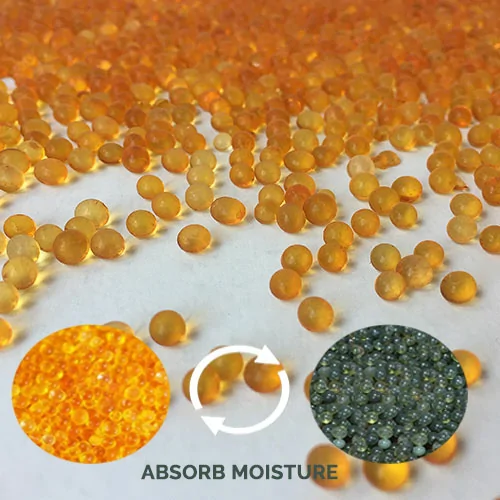
Features
- Orange when dry → turns green or colorless when saturated.
- Non-toxic and safe: Free of cobalt chloride.
- Eco-friendly: Compliant with EU and US safety standards.
- Regenerable: Can be reused after heating.
Applications
- Food packaging: Tea, coffee, spices, and snacks.
- Pharmaceuticals: Protects tablets and capsules.
- Consumer goods: Electronics, clothing, leather.
- Environmentally sensitive industries: Where safety is a priority.
Orange silica gel is the preferred modern solution for many industries because it combines indicator function with safety compliance.
White vs Blue vs Orange Silica Gel – What is the Difference?
| Feature/Application | White Silica Gel | Blue Silica Gel | Orange Silica Gel |
|---|---|---|---|
| Moisture absorption | High | High | High |
| Color change | ❌ No | ✅ Blue → Pink | ✅ Orange → Green |
| Toxicity | Non-toxic | Contains cobalt chloride (toxic) | Non-toxic,eco-friendly |
| Cost | Low | Medium | Slightly higher |
| Reusability | Yes(heating) | Yes(heating) | Yes(heating) |
| Best Use | General packaging | Industrial,archival storage | Food,pharma,safe consumer use |
Which Type of Silica Gel is Best for You?

- For general use → Choose white silica gel.
- For monitoring needs → Choose blue silica gel, but be aware of toxicity concerns.
- For safe, eco-friendly applications → Choose orange silica gel.
Why Choose SORBSTAR Silica Gel Beads?
At SORBSTAR, we manufacture and supply a complete range of silica gel desiccants that meet global quality standards.
- Full product range: White, blue, and orange silica gel available.
- Custom packaging: From bulk beads to sachets and packets.
- Food & pharma safe: FDA and RoHS compliant options.
- Eco-friendly: Orange indicating silica gel as a non-toxic solution.
- Global supply capability: Serving logistics, healthcare, retail, and industrial sectors.
👉 Explore SORBSTAR Silica Gel Products
FAQ
What are silica gel beads used for?
Silica gel beads absorb moisture and protect electronics, pharmaceuticals, shoes, and food from humidity damage.
What is the difference between white, blue, and orange silica gel?
White silica gel is non-indicating, blue silica gel turns pink when saturated but contains toxic cobalt chloride, while orange silica gel is eco-friendly and turns green when saturated.
Is blue silica gel safe?
Blue silica gel contains cobalt chloride, classified as toxic. While safe when sealed, it is being replaced by safer orange silica gel.
Can silica gel beads be reused?
Yes. All types can be regenerated by heating at 120–150°C.
Which type is best for food and pharmaceuticals?
Orange silica gel is the safest choice due to its non-toxic, eco-friendly composition.
Conclusion
Silica gel beads are a simple yet powerful solution for moisture control. While white silica gel is cost-effective for general use, blue silica gel provides visual monitoring but contains toxic cobalt chloride, and orange silica gel offers a safe, eco-friendly alternative with the same effectiveness.
Whether you need bulk silica gel beads, indicating desiccants for industrial use, or safe moisture absorbers for food and pharmaceuticals, SORBSTAR has the right solution.
Recommendations Links
Related Articles
If you found this article helpful, you may also be interested in our other resources on silica gel and desiccants:


